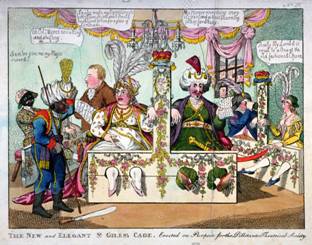
 The Pic Nic Society was a fashionable theatrical club founded in London in 1802, which attracted various decadent aristocrats....and also the attention of satirists.
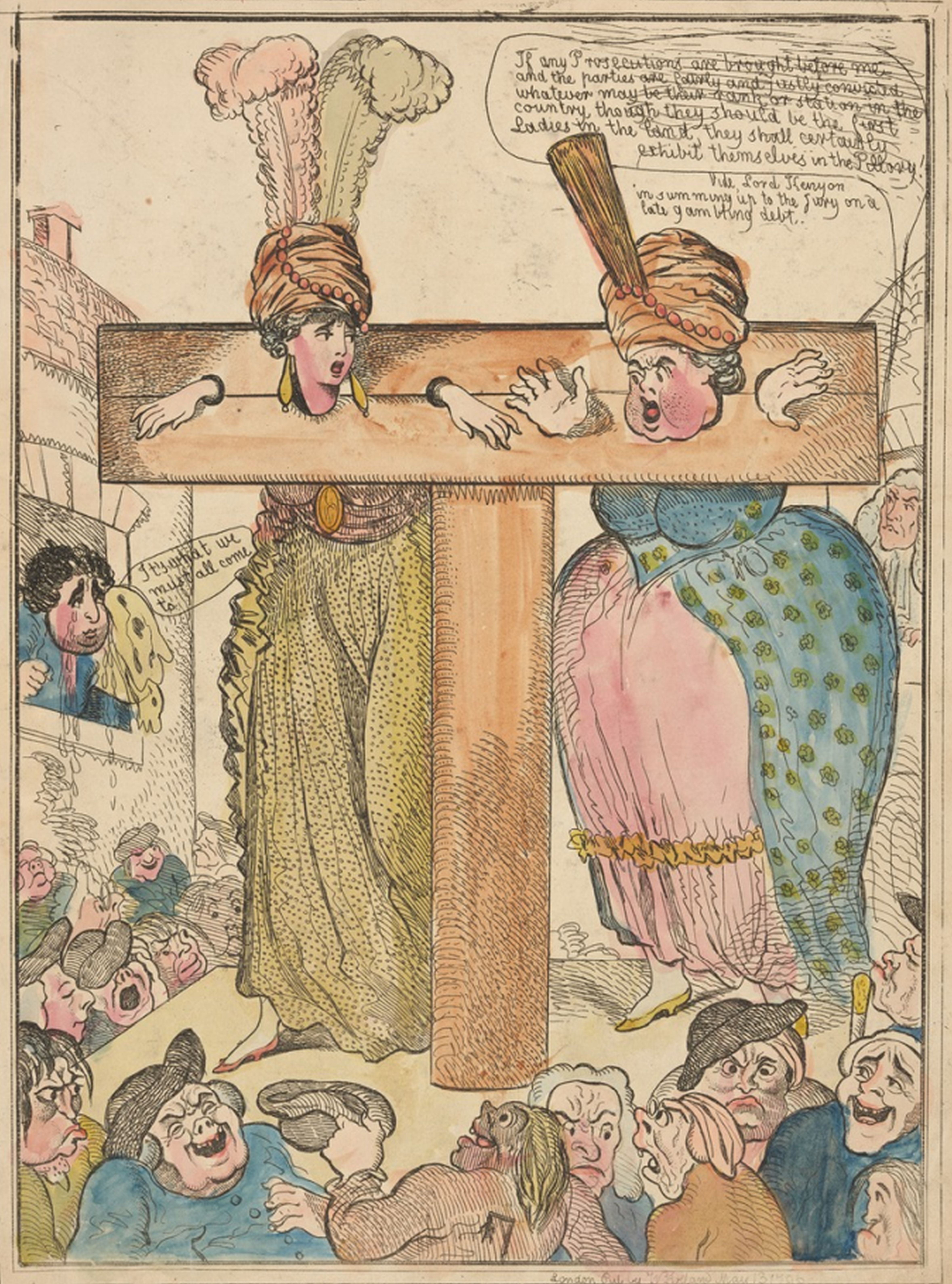
The man and the woman sitting in the ornate stocks in the centre are Colonel Greville and Lady Buckinghamshire. Yes, its Albinia again (see "Faro's Daughters"
above). The first performance by the Society was a comedy set in Spain under the Moors, hence the Moorish costumes.
The Pic Nic Society was a fashionable theatrical club founded in London in 1802, which attracted various decadent aristocrats....and also the attention of satirists.
The man and the woman sitting in the ornate stocks in the centre are Colonel Greville and Lady Buckinghamshire. Yes, its Albinia again (see "Faro's Daughters"
above). The first performance by the Society was a comedy set in Spain under the Moors, hence the Moorish costumes.
As players at an unlicensed theatre
these amateur actors colud potentially be threatened with vagrancy proceedings, which is why the satirist has depicted them in the stocks: "The new and elegant
St Giles cage. Erected on purpose for the dillitanti theatrical society." (1802) by Charles Williams.
Scotch Babes in the Wood
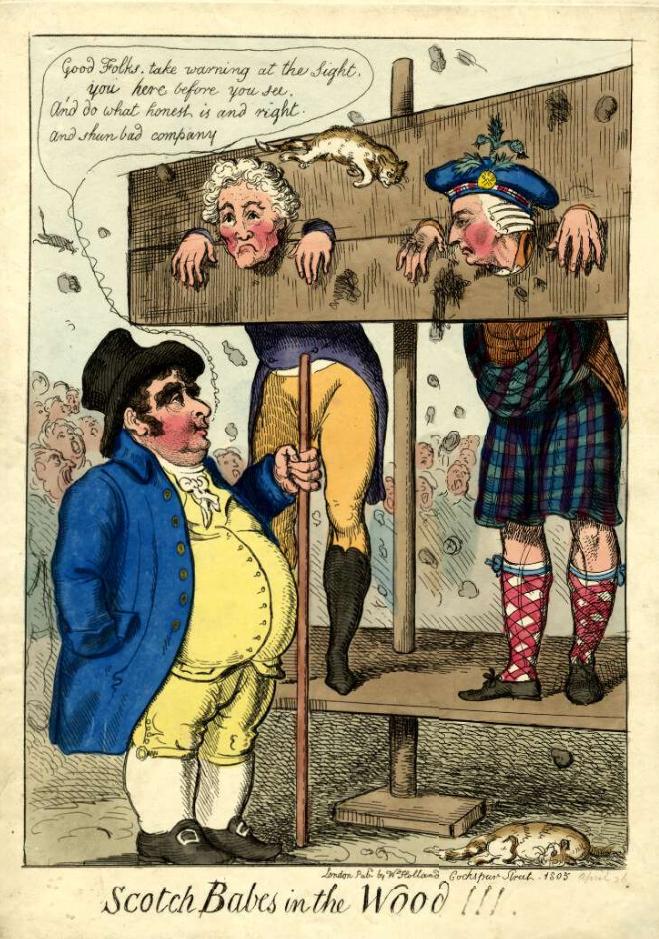
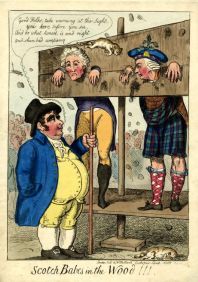 This picture is titled "Scotch Babes in the Wood" and dates from 1805. The figures confined in the pillory are John Trotter (left) and Henry Dundas (Viscount Melville), who was First Lord of the Admiralty. Both had been censured in the UK Parliament for misappropriation of public funds. Standing in front of the pillory is Charles James Fox (leader of the Whig party), depicted as a constable. The speech bubble above Fox reads: "Good Folks, take warning at the Sight, You here before you see, And do what honest is and right, And shun bad company".
Look at the Leaders
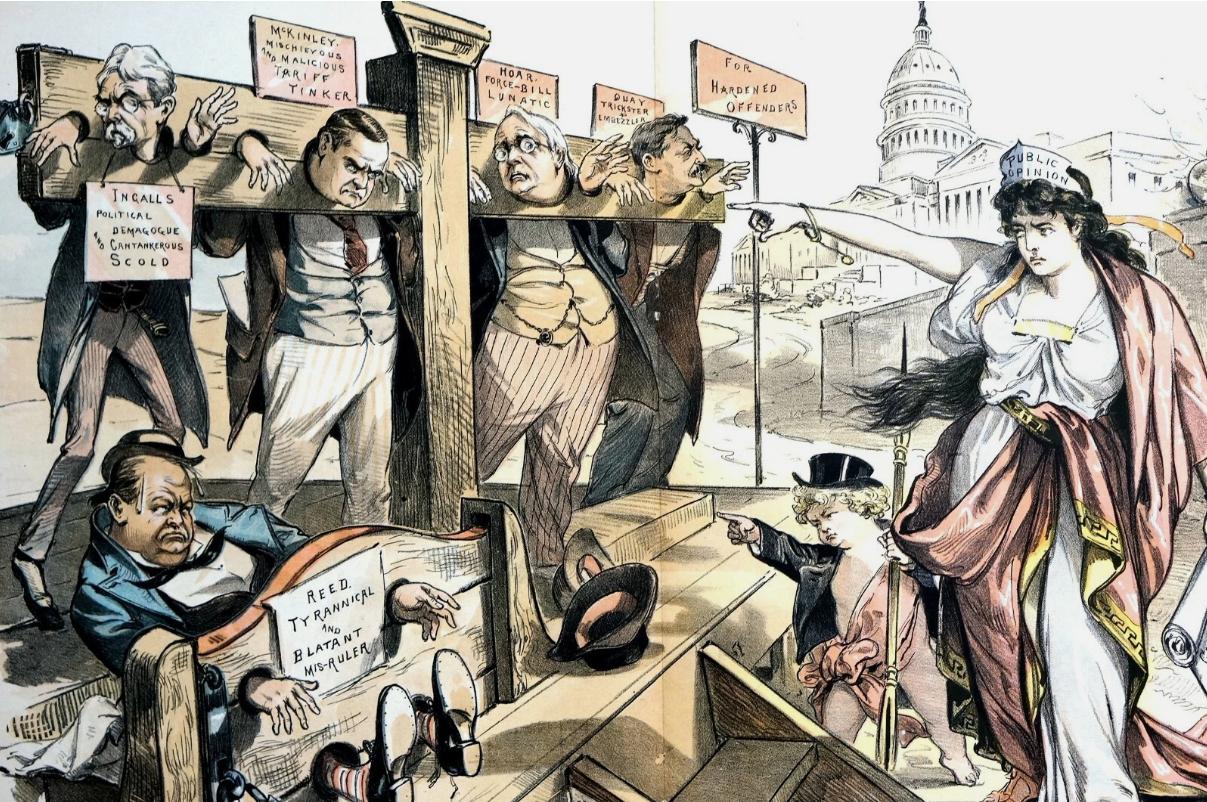
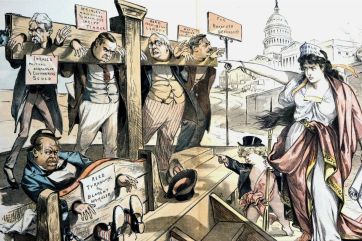 This picture is titled "Look at the Leaders of the Disgraceful Fifty-First Congress!", and was published in “Puck” magazine on 18 March 1891. The cartoon depicts
Senator Matthew Quay, Speaker Thomas Brackett Reed, Senator John J. Ingalls, Representative William McKinley, and Senator George Frisbie Hoar. They were leading
politicians in the contentious 51st United States Congress, which was dogged by political scandals and controversies.
This picture is titled "Look at the Leaders of the Disgraceful Fifty-First Congress!", and was published in “Puck” magazine on 18 March 1891. The cartoon depicts
Senator Matthew Quay, Speaker Thomas Brackett Reed, Senator John J. Ingalls, Representative William McKinley, and Senator George Frisbie Hoar. They were leading
politicians in the contentious 51st United States Congress, which was dogged by political scandals and controversies.
Fenians
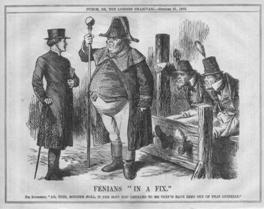 A forerunner to the IRA, the Fenians strove for the establishment of an independent Irish Republic in
the 19th and early 20th centuries. They were either freedom fighters or terrorists, depending on your point of view.
A forerunner to the IRA, the Fenians strove for the establishment of an independent Irish Republic in
the 19th and early 20th centuries. They were either freedom fighters or terrorists, depending on your point of view.
This cartoon was published in Punch (a British magazine) on 21 October 1865. At that time, the Fenian movement was relatively new and was
merely agitating for political change. In the cartoon the Fenians are being discussed in patronising tones by a bishop and a John Bull-like
beadle, both recognisable establishment figures. The Fenians in the stocks are portrayed as uncouth savages, tapping in to British prejudice
towards the Irish at that time.
The British government began to take the Fenians far more seriously following an armed uprising in 1867. When that failed, the Fenians began
a terrorist campaign of bombings and political assassinations. Following the establishment of an independent Irish Republic in 1922, this
terrorist campaign continued sporadically throughout the 20th century. The aim was to achieve independence for Northern Ireland, which remained
under British rule.
|
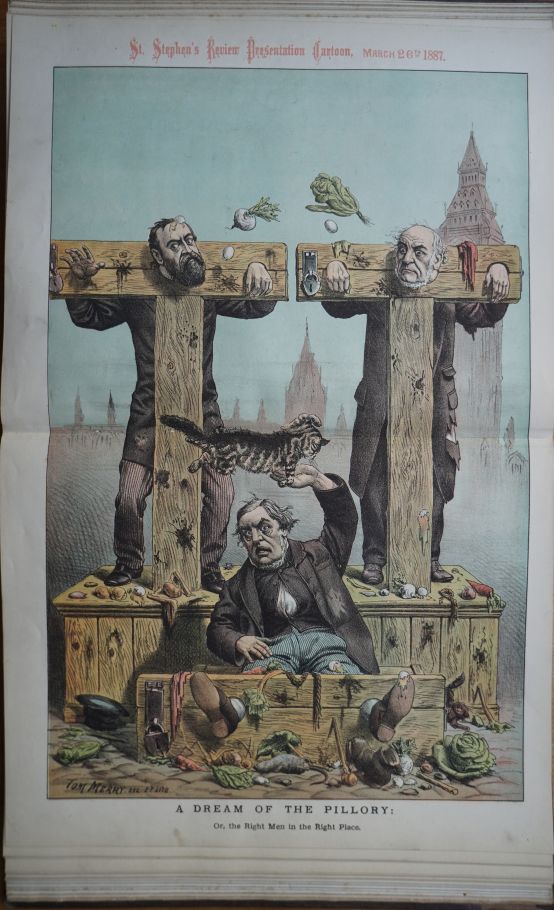
A Dream of the Pillory
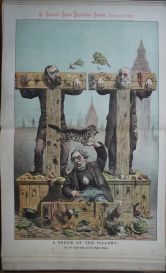 Following from "Fenians" (above), this cartoon satirises the political proponents of Irish home rule. I am uncertain of the identity of the man in the stocks. William Gladstone (the British Prime Minister at the time) occupies the right hand pillory. Charles Stewart Parnell (the Irish nationalist leader) is in the pillory on the left.
This cartoon was published on 26 March 1887 in a weekly magazine called "St Stephen's Review". The cartoonist signed himself as Tom Merry, whose real name was William Mecham.
|
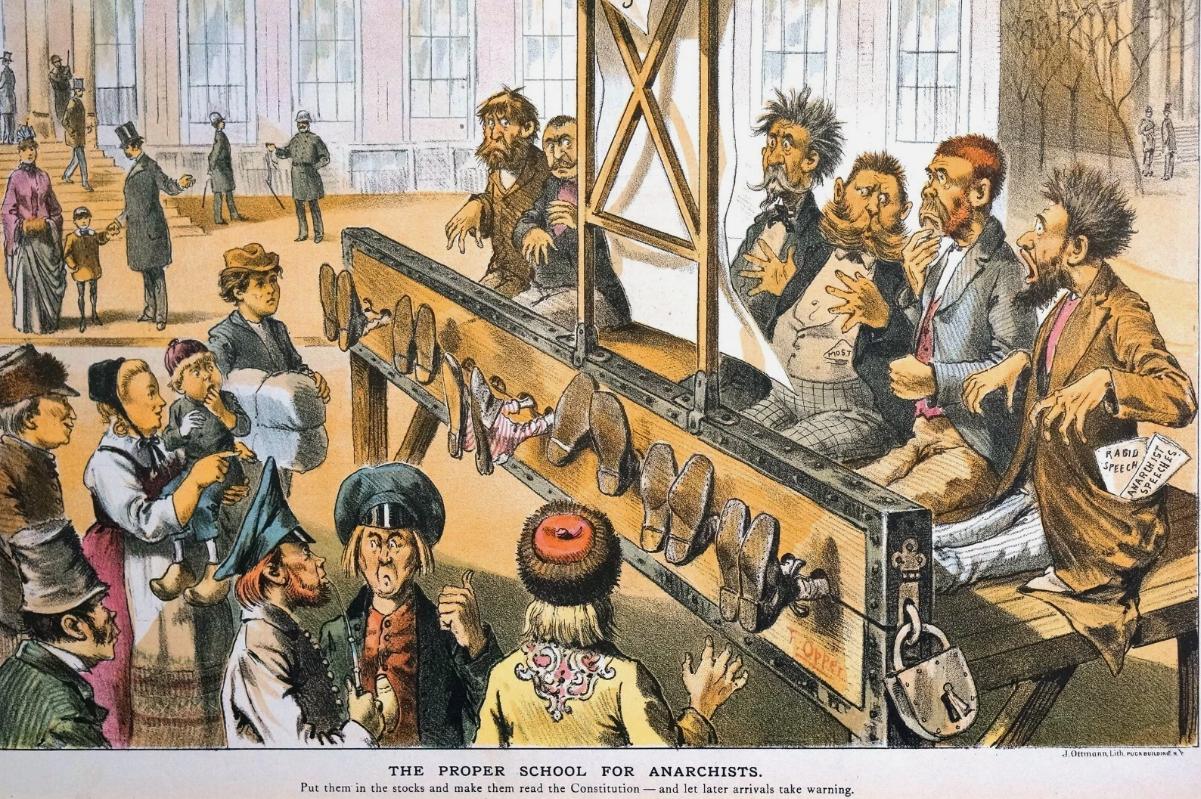
Anarchy_School
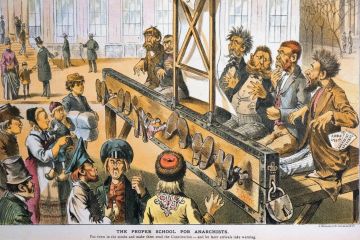 This picture is titled "The Proper School for Anarchists ", and was published in “Puck” magazine in December 1888. The Anarchist movement had a reputation for violent activism, including bombings and assassinations.
|
Beware the Coalition
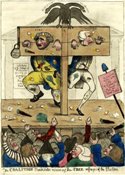 Charles James Fox and Lord Hood (both leading politicians in the late 18th century) shown in a pillory in Covent Garden, London. The mob is pelting them with eggs and vegetables for their perceived attempt to rig the General Election.
The text on the picture reads: "The Coalition Candidates receiving the free suffrages of the Electors". The padlock on the pillory is inscribed with "1790 Freedom of Election".
This cartoon was published in June 1790. The artist is William Dent.
|
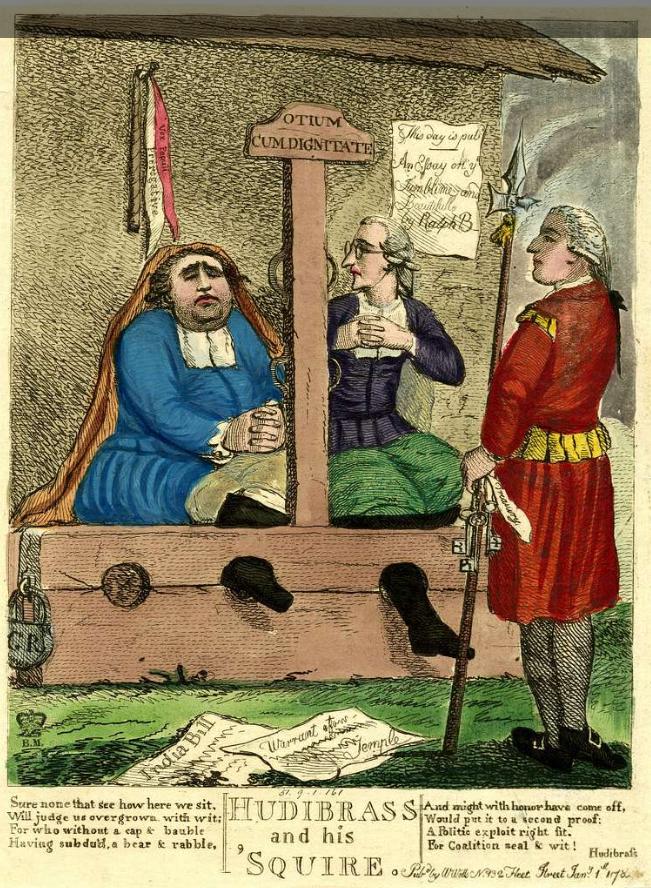
Hudibrass
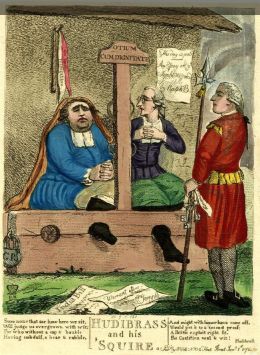 Charles James Fox (left) and Edmund Burke (right) sit side by side in the stocks as Hudibras and his squire Ralpho. William Pitt (the Younger) stands (right) holding a halberd and a bunch of three keys labelled 'Treasury'. All are in pseudo 17th century costume.
On the wall behind Fox hangs a scourge with two lashes, one inscribed 'Prerogative', the other 'Vox Populi', indicating the two causes of the fall of the Coalition (see "Beware the Coalition" above). Behind Burke's head is a placard: 'This day is published An Essay on ye Tumblime and Beautifull by Ralph B.' (an allusion to Burke's essay on 'The Sublime and the Beautiful').
In front of the stocks lie two papers inscribed 'India Bill' and 'Warrant of... Temple', since Temple had conveyed to the Lords the king's desire for the defeat of the India Bill. A whipping-post attached to the stocks is inscribed 'Otium cum Dignitate' (a Latin phrase which translates to "leisure with dignity" and refers to a state of dignified retirement and intellectual activity outside of public work or duty).
|
Scotch Babes in the Wood
|
This picture is titled "Scotch Babes in the Wood" and dates from 1805. The figures confined in the pillory are John Trotter (left) and Henry Dundas (Viscount Melville), who was First Lord of the Admiralty. Both had been censured in the UK Parliament for misappropriation of public funds. Standing in front of the pillory is Charles James Fox (leader of the Whig party), depicted as a constable. The speech bubble above Fox reads: "Good Folks, take warning at the Sight, You here before you see, And do what honest is and right, And shun bad company".
|
Quack doctors
 In previous centuries, it would have been difficult to distinguish between a genuine doctor and a quack
doctor, as the level of medical knowledge was generally abysmal. Many people would entrust their care to a village “wise woman”, rather than
turn to the medical practitioner. Doctors were expensive, and their remedies were as likely to kill as cure.
In previous centuries, it would have been difficult to distinguish between a genuine doctor and a quack
doctor, as the level of medical knowledge was generally abysmal. Many people would entrust their care to a village “wise woman”, rather than
turn to the medical practitioner. Doctors were expensive, and their remedies were as likely to kill as cure.
Things started to improve in the 19th century and, in 1858, the UK Parliament passed the Medical Act which provided for a register of qualified
doctors. The Act also attempted to regulate the unqualified and unscrupulous “quacks” who often promoted their dubious cures on the streets, or
in newspapers and magazines.
The threat of prosecution did little to deter the sale of unlicensed patent medicines (then and now), and the gullible continued to be taken in
by extravagant claims to cure almost everything. At best these medicines were harmless placebos; at worst they were actively poisonous. It was
not unknown for some of these cures to contain lead, arsenic and other proven toxins.
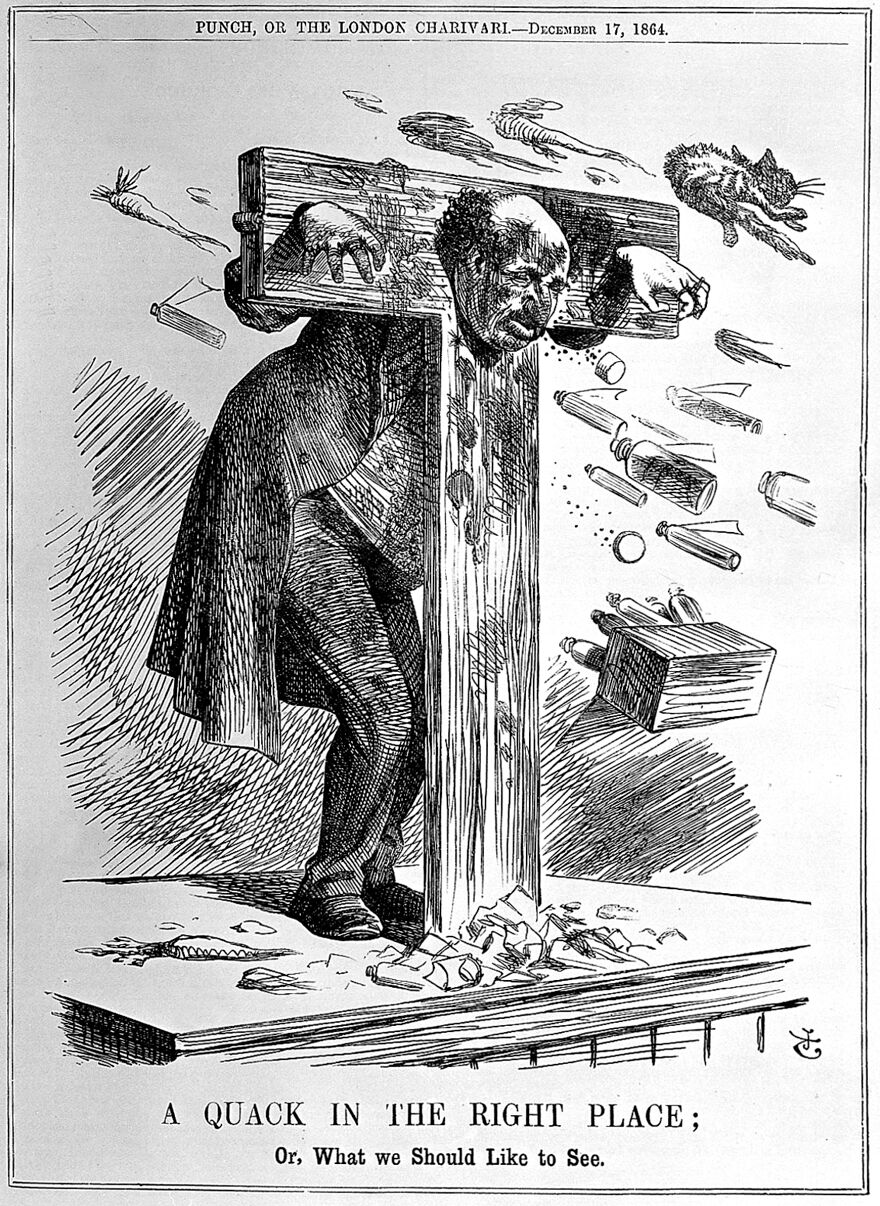
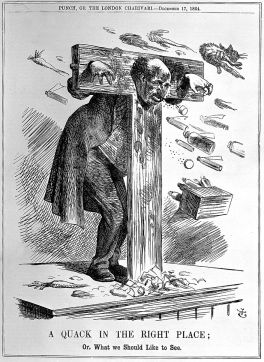
This cartoon was published on 17 December 1864, and depicts a quack doctor in the pillory. In addition to the traditional vegetables and dead
cats, the quack is also being pelted with his own dubious medicines.
|
Dreyfus
 The Dreyfus affair was a political scandal that divided France from its inception in 1894 until its resolution
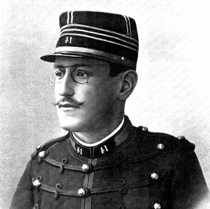
in 1906. It involved the conviction for treason in November 1894 of Captain Alfred Dreyfus (pictured), a young French artillery officer of Alsatian Jewish
descent. Sentenced to life imprisonment for allegedly having communicated French military secrets to the German Embassy in Paris, Dreyfus was
sent to the penal colony at Devil's Island in French Guiana, where he spent almost five years.
The Dreyfus affair was a political scandal that divided France from its inception in 1894 until its resolution
in 1906. It involved the conviction for treason in November 1894 of Captain Alfred Dreyfus (pictured), a young French artillery officer of Alsatian Jewish
descent. Sentenced to life imprisonment for allegedly having communicated French military secrets to the German Embassy in Paris, Dreyfus was
sent to the penal colony at Devil's Island in French Guiana, where he spent almost five years.
Two years later, in 1896, evidence came to light identifying a French Army major named Ferdinand Walsin Esterhazy as the real culprit. After
high-ranking military officials suppressed the new evidence, a military court unanimously acquitted Esterhazy after the second day of his trial.
The Army accused Dreyfus of additional charges based on false documents. Word of the military court's framing of Dreyfus and of an attendant
cover-up began to spread, chiefly owing to “J’accuse”, a vehement open letter published in a Paris newspaper in January 1898 by the notable
writer Émile Zola. Progressive activists put pressure on the government to reopen the case.
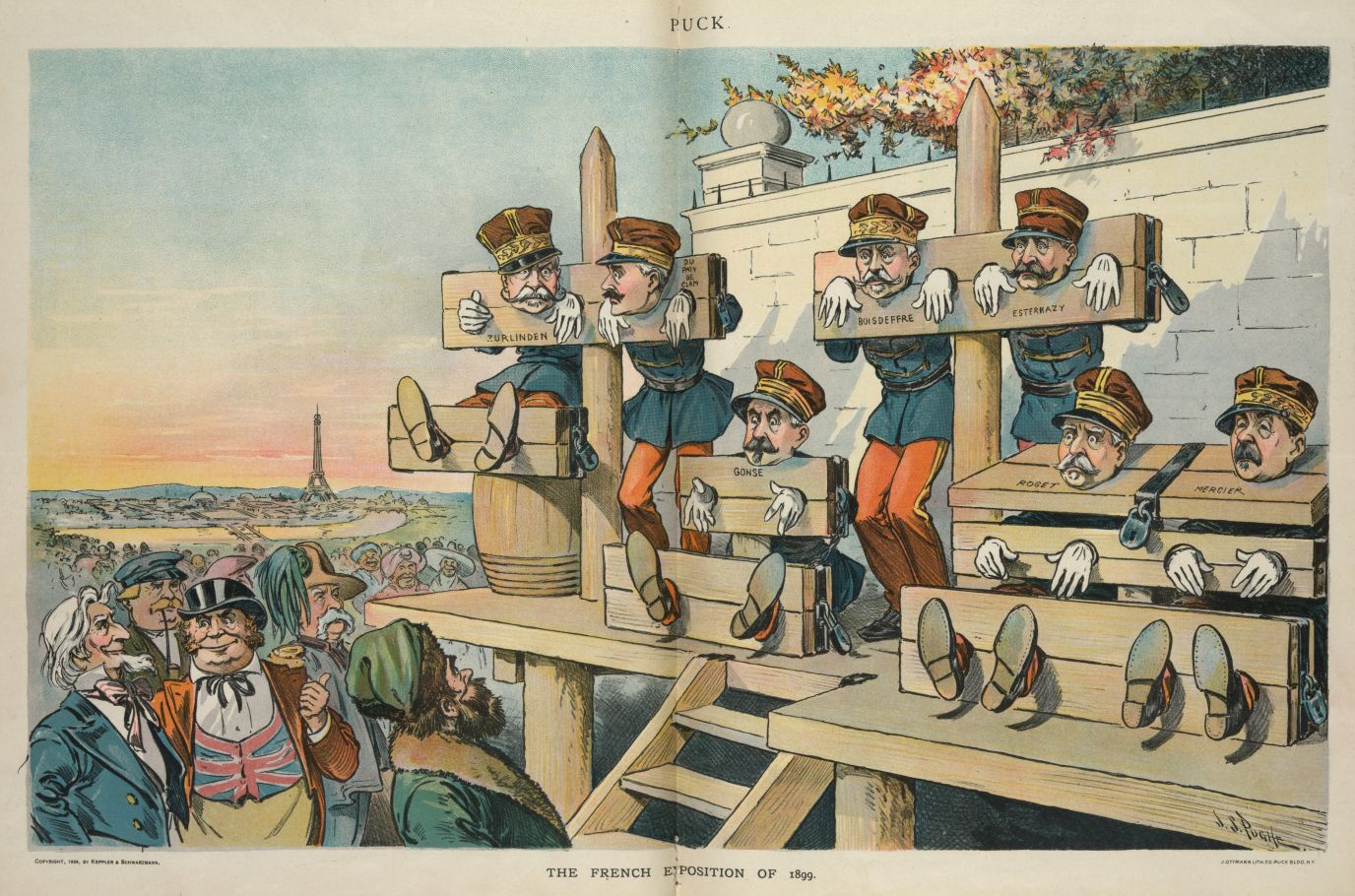
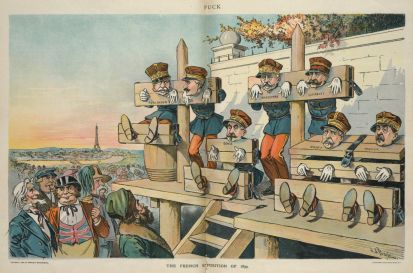
In this cartoon, the French generals who had attempted to frame Dreyfus (ostensibly for anti-semitic reasons) are in stocks and pillories,
exposed to international condemnation. Their disgrace is being viewed by characters representing all the nations of the world, with Uncle Sam
and John Bull prominently in the foreground.
In 1899, Dreyfus was brought to France for another trial. The intense political and judicial scandal that ensued divided French society between
those who supported Dreyfus those who condemned him. The new trial resulted in another conviction and a 10-year sentence, but Dreyfus was given
a pardon and set free.
Eventually, all the accusations against Alfred Dreyfus were demonstrated to be baseless. In 1906, Dreyfus was exonerated and reinstated as a
major in the French Army. He served during the whole of World War I, ending his service with the rank of Lieutenant-Colonel.
|
Napoleon Bonaparte
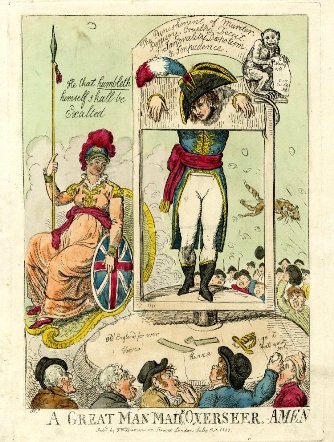 The French emperor, Napoleon Bonaparte, is portrayed in the pillory being pelted by an English crowd. Beside him sits Britannia on a throne, representing England. Above the pillory is a sign detailing Napoleon's alleged crimes: "The punishment of murder, perjury, cruelty, deceit, immorality, despotism and impudence".
A monkey sits on top of the pillory, which could allude to a popular legend. The story goes that during the Napoleonic Wars, a French ship was wrecked off Hartlepool, a fishing village on the north-east coast of England. The only survivor was the ship's mascot, a monkey which was washed ashore.
The people of Hartlepool had never seen a monkey before - nor had they ever set eyes on a Frenchman. Mistaking its chattering for the language of the enemy, they convicted the monkey of being a French spy and hanged the animal on the beach. Even to this day, people from Hartlepool are sometimes referred to as "monkey hangers".
A hand-coloured etching, dated 20 July 1803. Napoleon was First Consul of the French Republic at that time, but had himself proclaimed Emperor the following year.
|
In the Interest of Labor and Morality
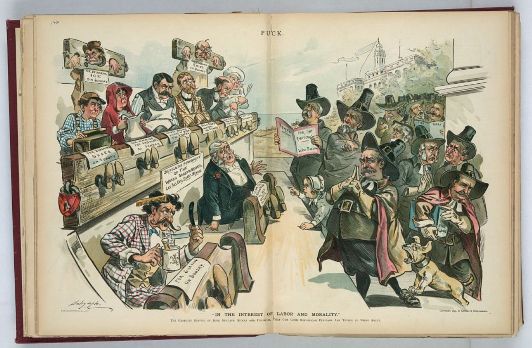 This is an illustration by Louis Dalrymple which was published in "Puck" magazine on 16 October 1895. It ridicules the puritanical approach taken by
the authorities at the time, particularly in regard to trading on Sundays.
This is an illustration by Louis Dalrymple which was published in "Puck" magazine on 16 October 1895. It ridicules the puritanical approach taken by
the authorities at the time, particularly in regard to trading on Sundays.
The picture shows, on the left, many businessmen and women in stocks and pillories for such offences as "serving guests wine on Sunday", "for shaving on
Sunday", "for delivering ice on Sunday", "for selling a glass of beer on Sunday", "for blacking shoes on Sunday", and "for working the growler on Sunday";
a notice states "Behold the Punishment of the Wicked Sabbath Breaker. Let All Evil Doers Beware".
On the right is a group of New York legislators dressed as puritans, including Lieut. Governor Charles T. "Saxton", Thomas C. "Platt", Jacob M. "Patterson",
Hamilton "Fish", Frederick S. "Gibbs", Warner "Miller", Governor Levi P. "Morton", Chauncey M. "Depew" and Jacob S. "Fassett".
The caption underneath the drawing says: "The glorious revival of blue Sundays, stocks and pillories, that our good Republican Puritans are trying to bring about".
Citation: Bos, Carole "To the Pillory "In the Interest of Labor and Morality"" AwesomeStories.com. Mar 16, 2016.
|
Bully Brooks
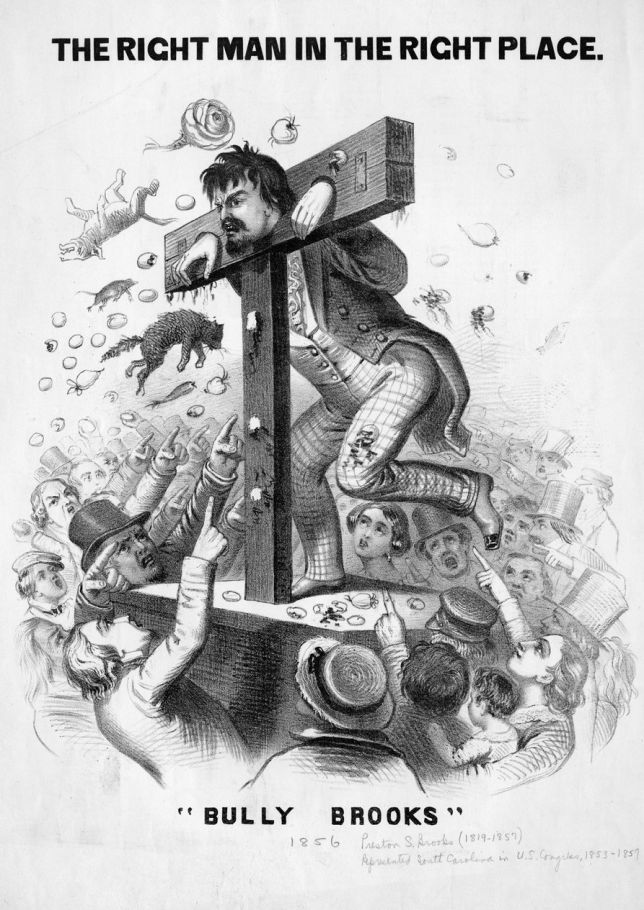
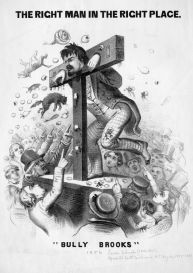 "Bully Brooks" is a nickname for Preston Smith Brooks, a US Representative from South Carolina, who became infamous for attacking Senator Charles Sumner on the floor of the US Senate on 22 May 1856. Brooks confronted Sumner, who was seated at his desk, and beat him with a gold-headed cane, causing severe injuries.
This incident, known as the "Caning of Sumner," was motivated by Sumner's anti-slavery speech in which he criticised Brooks' relative, Senator Andrew Butler. The attack sparked outrage in the North, with many viewing Brooks as a violent aggressor and calling him "Bully Brooks". Southern newspapers, on the other hand, largely praised Brooks for defending his family's honour.
Brooks resigned from Congress but was quickly re-elected by his constituents. Sumner, while initially incapacitated, eventually returned to the Senate, though he continued to suffer from the lingering effects of the assault.
The attack on Sumner demonstrated the deep divisions and animosity between pro- and anti-slavery factions in the nation. It is seen as a contributing factor to the escalating tensions over slavery that led eventually to the American Civil War.
|
Ye Scolds
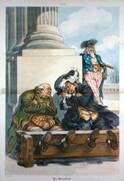 An illustration by Udo Keppler published in "Puck" magazine on 3 February 1909. A heavy set man depicting Congress and Theodore Roosevelt, both in colonial dress, sit beside each
other, locked in a stockade at the ankles. Congress, with arms folded, looks angrily at Roosevelt who, with arms folded, thumbs his nose at his adversary. Their
backs are against the base of a column beside which stands Uncle Sam in a three-cornered hat, who guards them with a billy club.
An illustration by Udo Keppler published in "Puck" magazine on 3 February 1909. A heavy set man depicting Congress and Theodore Roosevelt, both in colonial dress, sit beside each
other, locked in a stockade at the ankles. Congress, with arms folded, looks angrily at Roosevelt who, with arms folded, thumbs his nose at his adversary. Their
backs are against the base of a column beside which stands Uncle Sam in a three-cornered hat, who guards them with a billy club.
|
Pillory of Disgrace
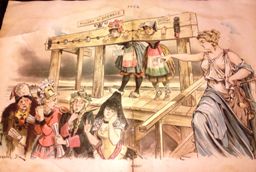 The cartoon shows two European nations, represented by allegorical figures, being held in a pillory labeled "Pillory of Disgrace". The figures in the pillory have text on their clothing or the pillory itself referencing specific events like the "Siberian Horror" and the "Panama Scandal". A figure representing the United States, depicted as a woman with a star-spangled banner, points an accusing finger at the disgraced nations. Representations of other European nations in the foreground wonder which of them will be in the pillory next.
The cartoon reflects the era's political climate and American sentiments towards European powers and their scandals. Alternatively titled "America Demands Justice", this cartoon was published in Puck magazine on 23 January 1889. The artist was Joseph Keppler.
|
Cleveland Holds the Key to the Situation
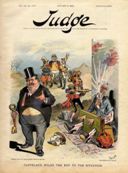 The man on the left is Grover Cleveland, the 22nd and 24th President of the United States. He is holding a large key. The figure in the stocks on the right is a personification of the Democratic Party, which is labeled as "Presidential" on the stocks. Representations of major European countries look on from the background.
The cartoon suggests that Cleveland, a Democrat, was seen as holding the key to the political situation at the time, particularly regarding the future of the Democratic Party.
This image appeared on the cover of the satirical magazine "Judge", published on 9 January 1897. The artist was Bernard Gillam. "Judge" magazine was known for its political cartoons that often attacked the Democratic administration and supported the Republican party.
|
Suffragettes
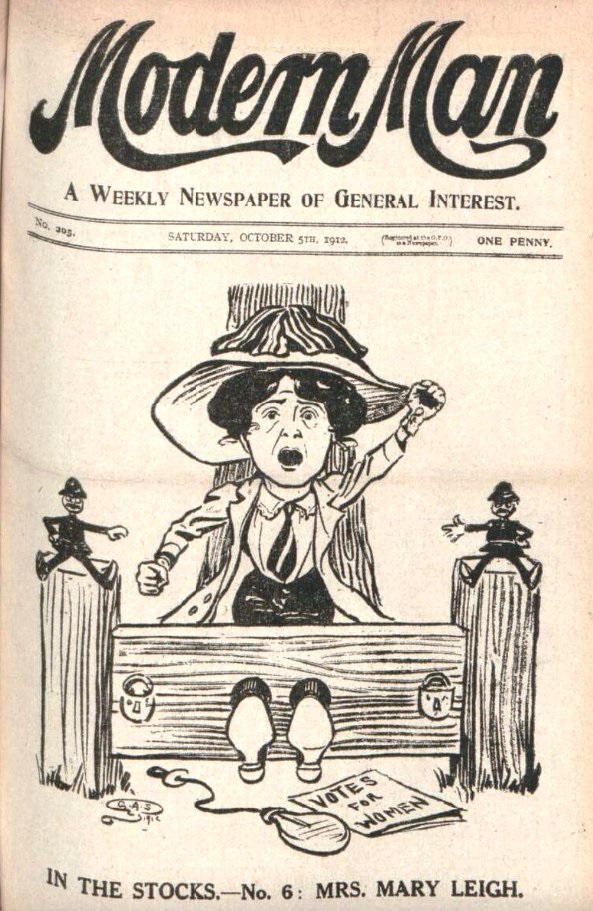
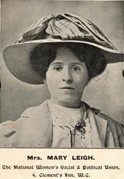 In the early 20th century, the suffragette movement campaigned for women to be able to vote in UK elections. This attracted a great deal of hostility from the government and others who disagreed with their cause. This was componded by the militant methods employed by some of the more extreme suffragettes, who were prepared to use violence to further their cause.
This cartoon was published in "Modern Man" on 5 October 1912. The magazine did not disguise its abhorrence towards the more militant suffragettes, referring to them as "female criminal lunatics".
The target of this cartoon, Mary Leigh, was a hard line suffragette. She was arrested and imprisoned regularly for leading violent demonstrations. In 1909, Mary and two other women climbed on to a roof in Birmingham to disrupt a meeting where the Prime Minister, Herbert Asquith, was making a speech. They threw roof tiles at the police and Asquith's car. In 1912 in Dublin, Mary attempted to assassinate Asquith by throwing a hatchet at him. She missed her target and instead injured John Redmond, an Irish nationalist leader.
During her imprisonment, Mary went on hunger strike, a tactic often employed by suffragettes. This resulted in her being force fed, although concern for her deteriorating health led the authorities to release her early.
The suffragettes eventually achieved their goal when equal voting rights were accorded to women in 1928. Mary Leigh lived into her 90s, dying in 1978.
|
Anticipations for the Pillory
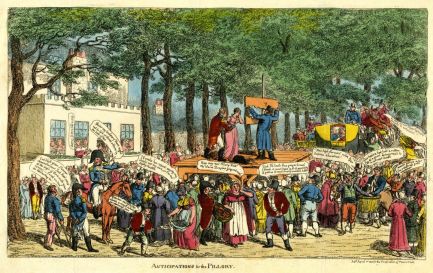
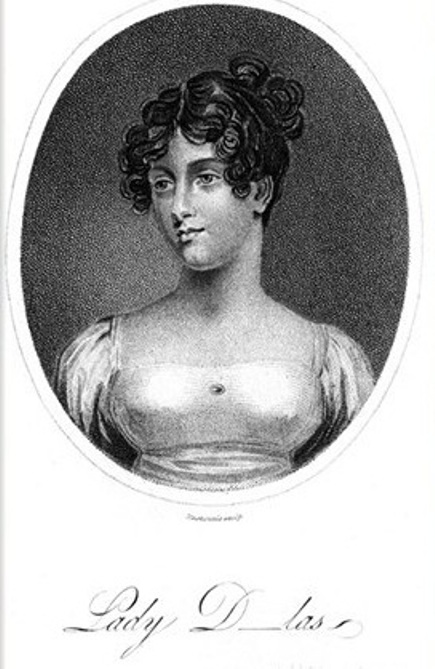 In 1805 Lady Charlotte Douglas (pictured) made a number of accusations against Princess Caroline, the wife of the future King George IV. Lady Douglas alleged that Princess Caroline was an adulteress, and that her adopted son was a bastard from an illicit affair. Lady Douglas also claimed that Princess Caroline had been rude about the royal family, and had touched her in an inappropriately sexual way. A secret commission investigated these claims and found no substance to them. No action was taken against Lady Douglas, possibly to avoid further scandal.
In 1813 Lady Douglas reiterated these allegations in writing, and swore an oath to their veracity. This sparked yet more outrage, mainly against Lady Douglas as Princess Caroline was popular with the public. The punishment for perjury was the pillory, so Lady Douglas should have been publicly pilloried for making false allegations under oath. But once again the matter was swept under the carpet as a damage limitation exercise. However public opinion was in no doubt that Lady Douglas should have stood in the pillory.
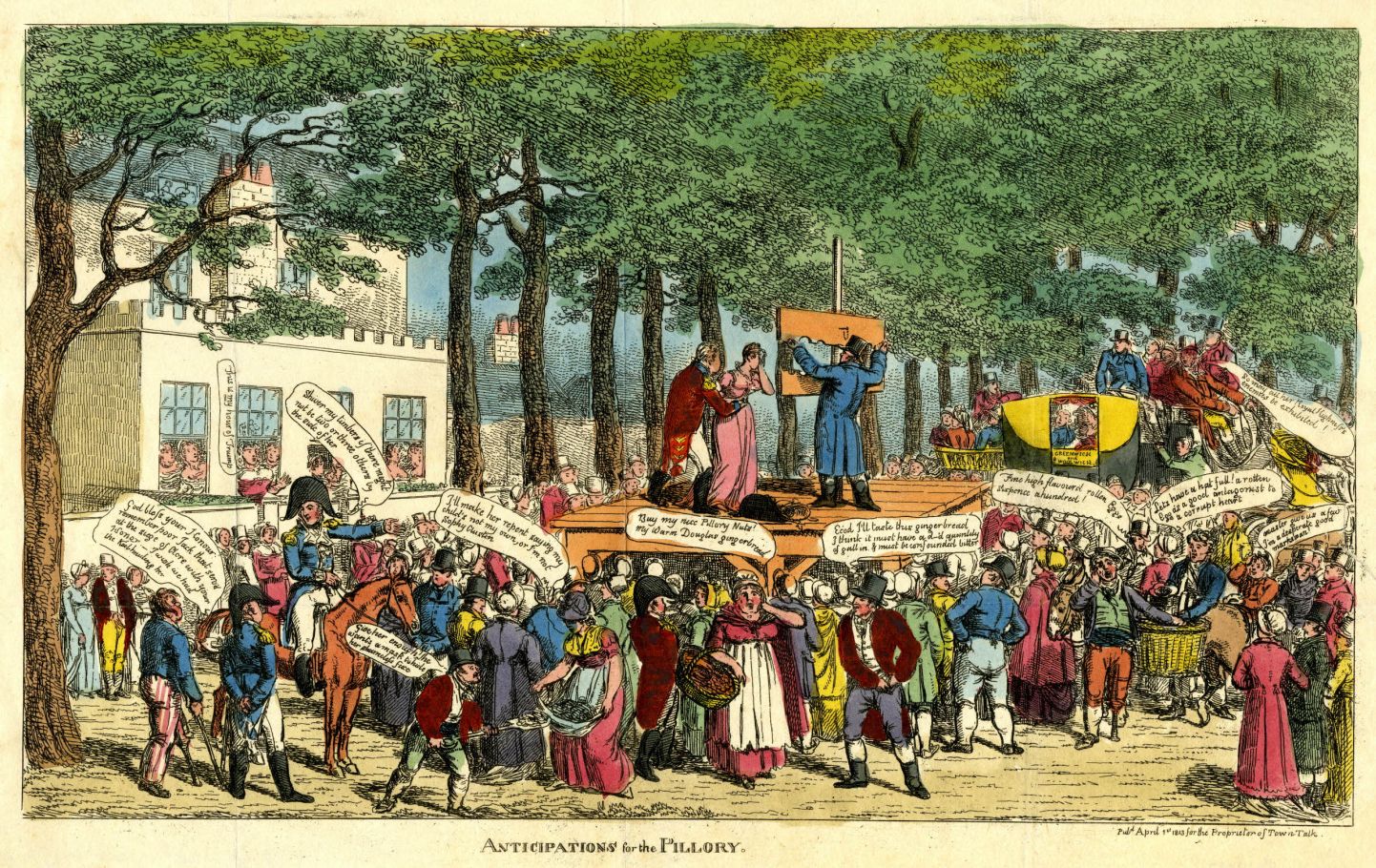
The cartoon depicts a pillory outside Montagu House, the residence of Princess Caroline. The upper half of the pillory is being raised in readiness for Lady Douglas, who can be seen on the platform surrounded by a festive crowd.
The speech bubbles are numerous and hard to read, but here are a few examples. A woman holds out her apron to collect mud (or horse manure) shovelled up by a man who says: "Give her enough! She wants a mask to hide her shameless face." A woman with a large basket on her arm cries: "Buy my nice Pillory Nuts! My Warm Douglas gingerbread." A man with a wooden leg stands beside his pannier-laden donkey shouting: "Fine high flavour'd rotten Eggs sixpence a hundred!" A man holds out his hat, saying, "Lets have a hat full! a rotten Egg is a good antagonist to a corrupt heart." A boy holds out his hat, saying, "master give us a few I'm a desperate good marksman." In Montagu House, Princess Caroline looks out on the spectacle, saying: "This is my hour of Triump [sic]".
|
Petruchio's Patent Family Bedstead
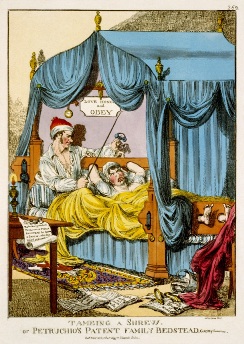 A cartoon by Thomas Tegg, published in 1815. This was part of a tradition of "humorous" images of "tyrannical" wives which continued through the 18th century and into the 19th century. The picture is based upon "The Taming of the Shrew", portraying the husband as Petruchio who is taming his errant wife. Above the bed is a sign "Love Honour and Obey", a reminder of the wife's marriage vows.
Although it may appear wildly misogynistic to modern eyes, this cartoon is very much a product of its time. An age when a wife was basically her husband's property, and she was expected to obey him. A married woman was not allowed to own any property in her own right, and she could be lawfully beaten by her husband.
|
Walcheren Expedition
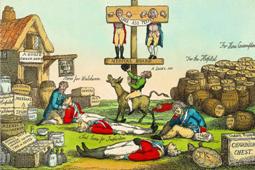 In July 1809, during the Napoleonic Wars, a large British military force departed for the island of Walcheren in the Netherlands. The military objectives were soon overshadowed by an epidemic of disease that largely destroyed the army. By the time the expedition ended in February 1810, the fever had caused the death of 60 officers and 3,900 soldiers. Almost half of the force had been struck down by disease, and six months later around 11,000 men were still registered sick.
The conduct of the army's senior medical officers (particularly Lucas Pepys and Thomas Keate) was severely criticised in a parliamentary inquiry. In this cartoon (dated 18 September 1810) Pepys and Keate are shown in a pillory, surrounded by dead and dying soldiers. There are also large quantities of spoof medical stores, lampooning the incompetence of the medical officers.
|
Thomas Cochrane
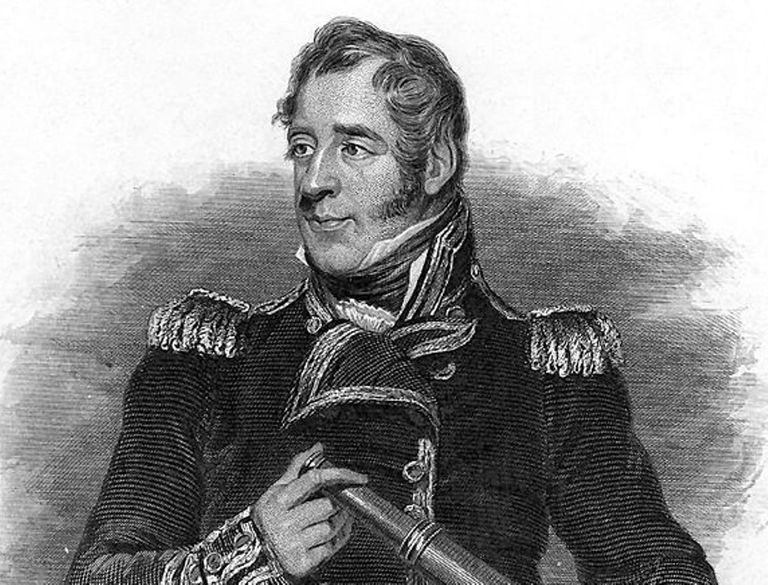 Thomas Cochrane, 10th Earl of Dundonald, was one of Britain's greatest naval heroes. Cochrane was the inspiration for the eponymous hero of the Horatio Hornblower books and television series. He was also the basis for the Captain Jack Aubrey books, on which the film "Master and Commander: The Far Side of the World" was based.
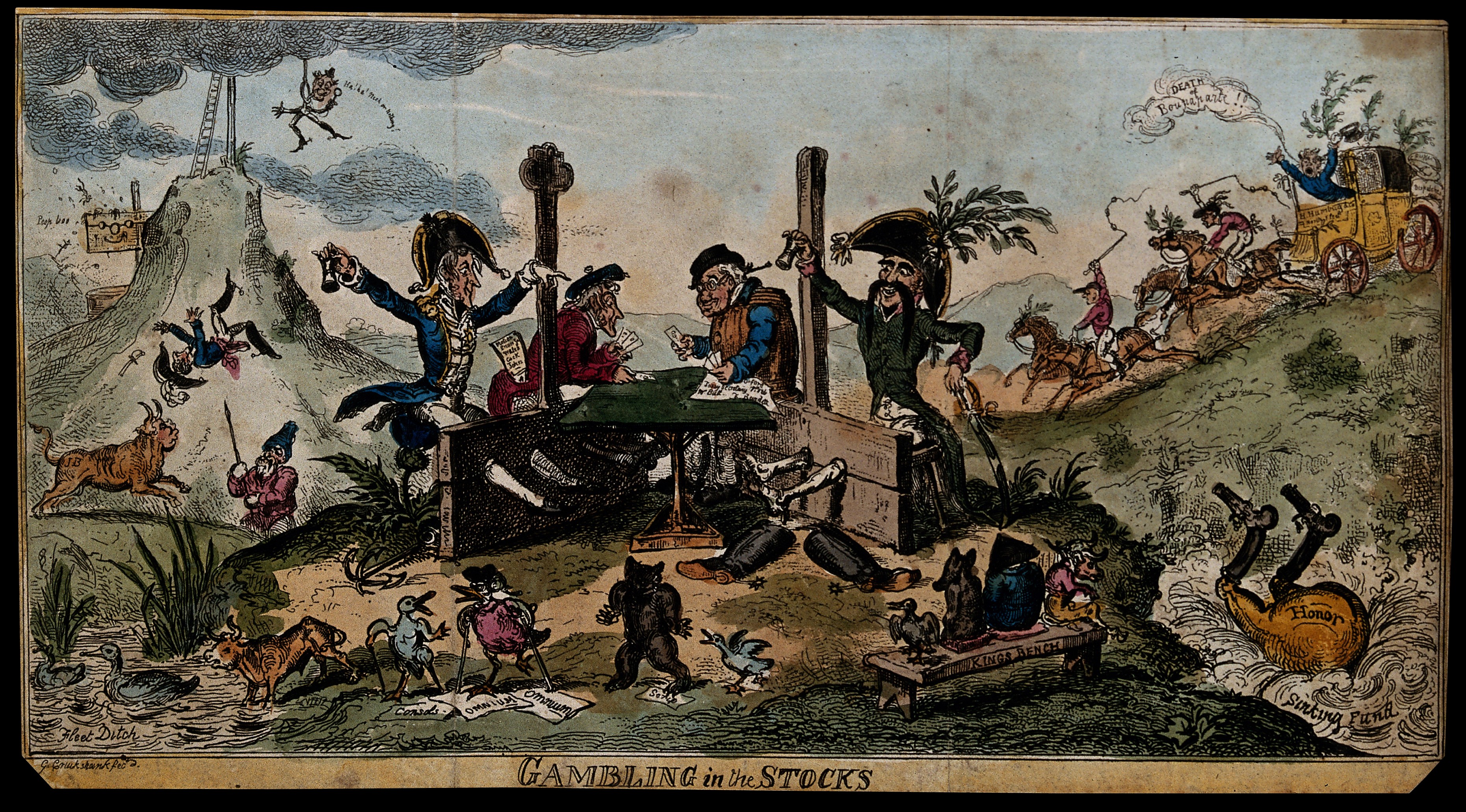
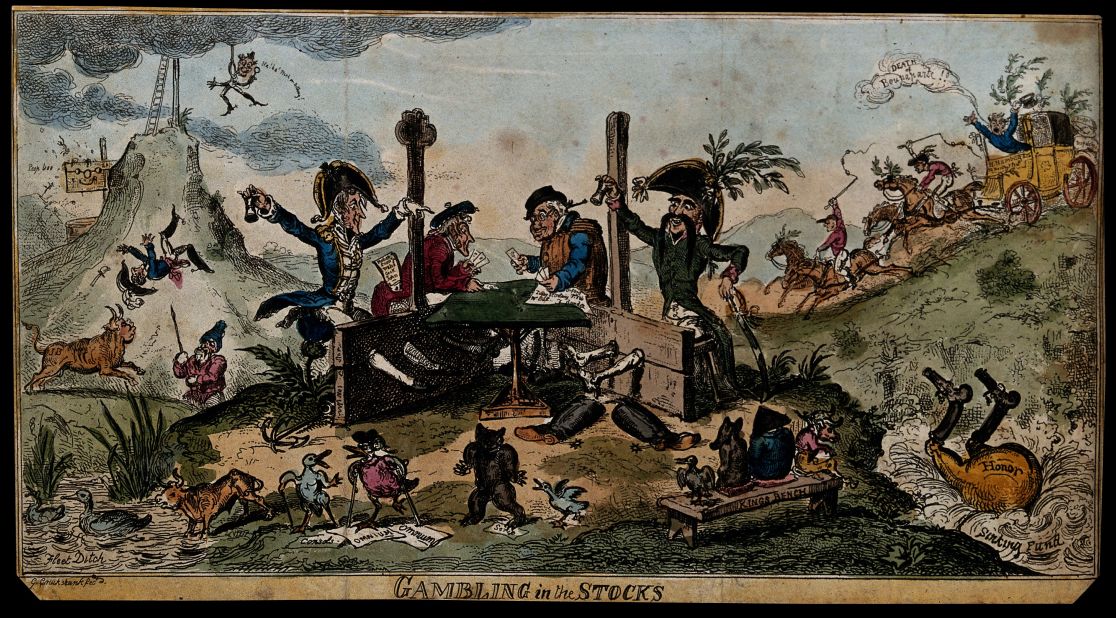
The headstrong and outspoken qualities which made Cochrane a brilliant captain worked against him when he campaigned for naval and parliamentary reform as a politician. In 1806 he was elected a Member of Parliament, where he railed against inefficiency and corruption at the Admiralty and among his fellow MPs. This made him a lot of powerful enemies. Eventually they moved against Cochrane, who was falsely implicated in the 1814 Stock Exchange fraud (which was based on false rumours about the death of Napoleon). At his trial Cochrane was fined £1,000, sentenced to the pillory and a year in jail, expelled from the Commons, and stripped of his knighthood.
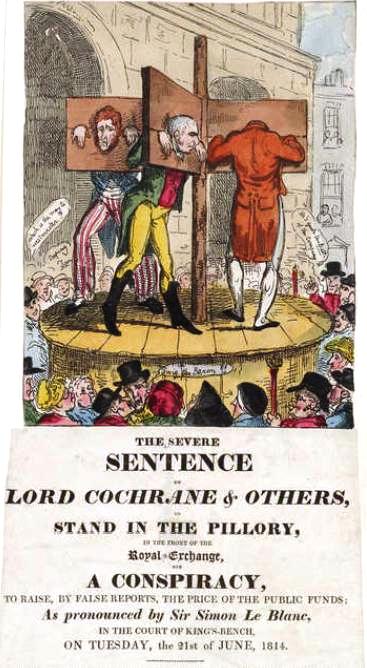 The cartoon on the left satirises Cochrane and his alleged accomplices in the fraud. However there was a subsequent public outcry against the Cochrane' sentence, particularly the pillory part. The cartoon on the right satirises the establishment, not Cochrane. Even Napoleon Bonaparte came to Cochrane’s defense. “Such a man should not be made to suffer so degrading a punishment,” he said at the time. The standing in the pillory was remitted, perhaps because Sir Francis Burdett, a fellow MP, proclaimed his intention of standing with Cochrane, but more likely because the government feared a riot.
 After his release from prison, Cochrane left Britain to perform some of his greatest exploits while commanding the navies of Brazil, Chile, Peru and Greece in their struggles for independence.
Cochrane was 53 years old in 1828 when he returned permanently to Britain. A new king, William IV, was sympathetic to his cause, and Cochrane was reinstated and made rear admiral. In 1847, with his knighthood restored, he was made commander in chief of the navy’s North American and West Indian stations. Cochrane died in 1860 and is buried in Westminster Abbey in London.
|

[Return to index page]
Last modified 23 April 2026.
Copyright © StocksMaster. All rights reserved.
|
|
|

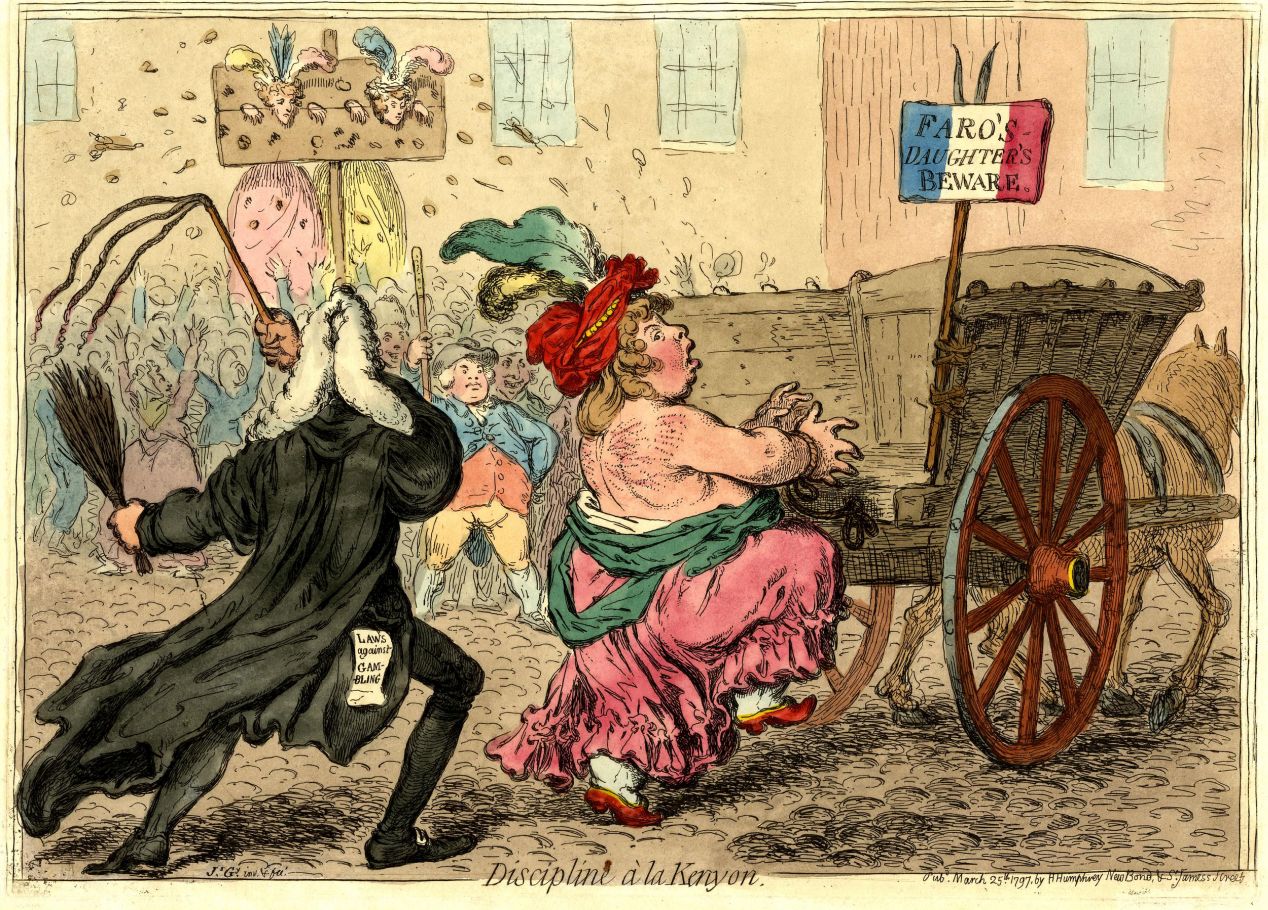
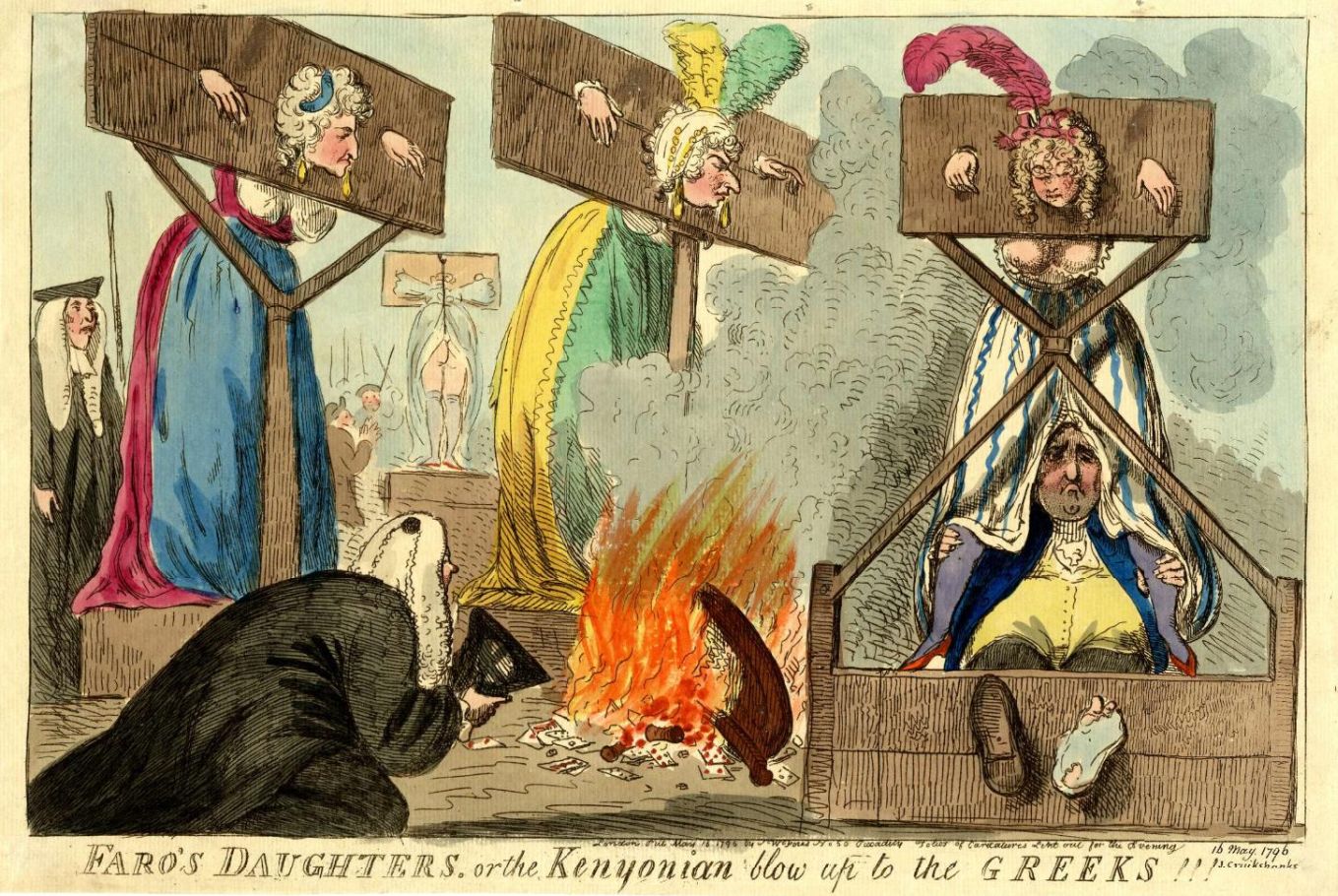
 Albinia, Countess of Buckinghamshire (pictured), was notorious for her gambling parties in the late 18th and
early 19th centuries. She was particularly fond of faro, an illegal gambling game. Albinia and her aristocratic lady friends were often
attacked in satirical prints because of their gambling and decadent lifestyles.
Albinia, Countess of Buckinghamshire (pictured), was notorious for her gambling parties in the late 18th and
early 19th centuries. She was particularly fond of faro, an illegal gambling game. Albinia and her aristocratic lady friends were often
attacked in satirical prints because of their gambling and decadent lifestyles.